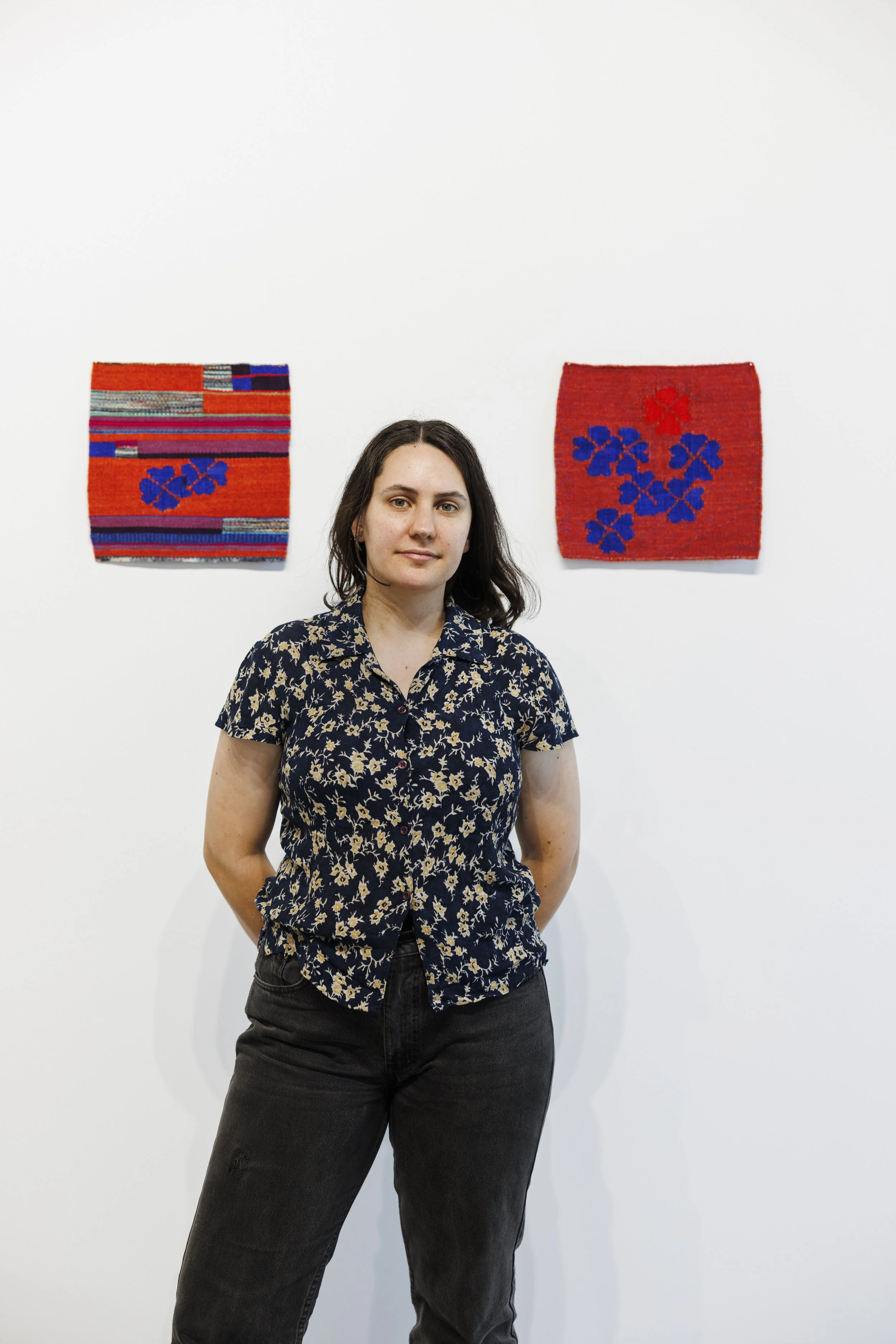
Bio
Nicole Clift is a visual artist and writer predominantly working in painting, tapestry weaving and installation. Nicole has exhibited across public, private and artist-run galleries including the Art Gallery of South Australia, PADA Studios - Portugal, Post Office Projects, FELTspace ARI, Central Gallery, Staff Only, Floating Goose Studios, Newmarch Gallery and Firstdraft gallery Sydney.
In early 2026, Nicole participated in the International Studio Program at PADA Studios, Portugal for 2 months working on new spatial and architectural approaches to painting and tapestry weaving, with support from CreateSA and the Ian Potter Foundation. This culminated in an group exhibition held in Barreiro, Portugal curated by architect/curator Sérgio Fazenda Rodrigues.
Two tapestries woven on this residency were selected for the 2026 Fleurieu Biennale Art Prize. Another 2026 tapestry was selected for the Petite Miniature Textiles Award (biennial) at Wangaratta Gallery, Victoria.
In 2024 Nicole was commissioned to create new work for the 2024/5 major survey exhibition Radical Textiles for the Art Gallery of South Australia, exhibiting alongside works by Sheila Hicks, Sonia Delaunay, Kiki Smith and more.
Nicole’s writing has been commissioned by fineprint magazine, the 2024 Neoterica exhibition publication, various solo exhibitions held in South Australia as well as the 2025 Wakefield Press monograph on Dr Sue Kneebone. Nicole holds a first-class Honours degree in Visual Art (2019) from Adelaide Central School of Art, South Australia.
Nicole’s studio is currently located at Post Office Projects, Port Adelaide, as part of their 2026/7 Studio Programme.
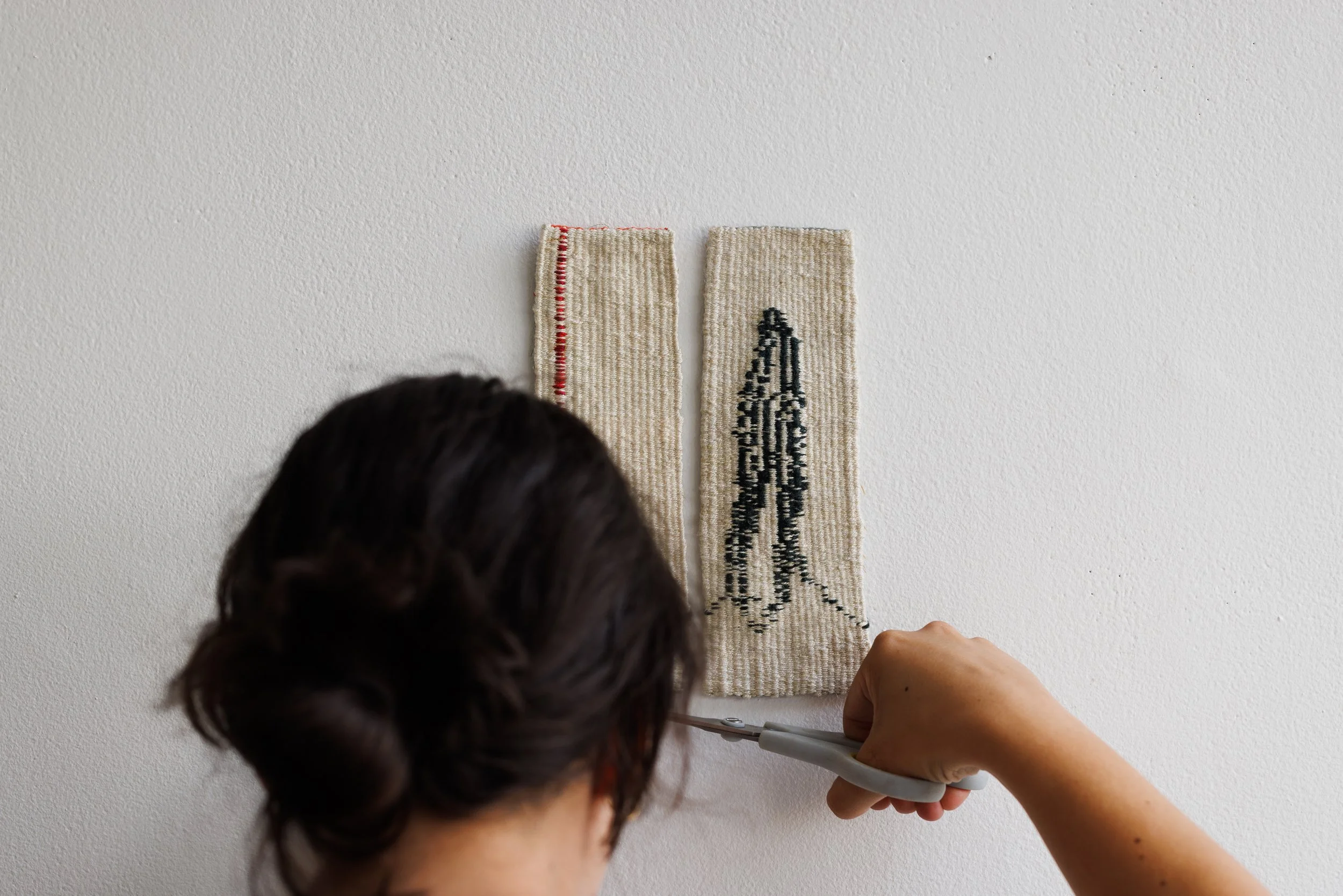
Artist Statement
My painted and woven surfaces are concerned with different types of density: optically through pattern and pigment saturation, as well as a physical material density. I feel this preoccupation with 'dense' or 'full' surfaces is my response to the increasingly intangible screen-based imagery of our time.
My curiosity for approaches to intangible planetary phenomena (time, light, entropy, gravity etc) bleed into my abstract paintings and handwoven tapestries by way of ancient motifs, modern abstraction and optical pattern. Engaging with these concepts, and with an ancient medium such as painting and tapestry weaving helps ground me within our current age of systems collapse.
I particularly enjoy the material density unique to tapestry, with each element of the design physically stored within the one surface. I like thinking of textile processes as, among many other significant things, highly complex ways of storing energy and material. In the same vein, I like to consider my tapestries as momentary configurations of wool and silk, which may one day be unwoven for another purpose. Temporal in nature.
Photos: Rosina Possingham